
Cut the Cable Bill, Keep the Live Sports: Why Smart US Households Are Switching to IPTV
If you have ever opened your monthly bank statement and felt a small jolt of pain at the "cable + sports package + streaming add-on" line, you are not alone. For millions of American families — and especially for credit union members who track every dollar of their household budget — entertainment subscriptions have quietly become one of the fastest-growing expenses on the books. The average household now pays for three or four streaming services on top of a legacy cable bill, and the sports fan in the house still complains that the big match is "blacked out" or locked behind yet another upgrade tier.
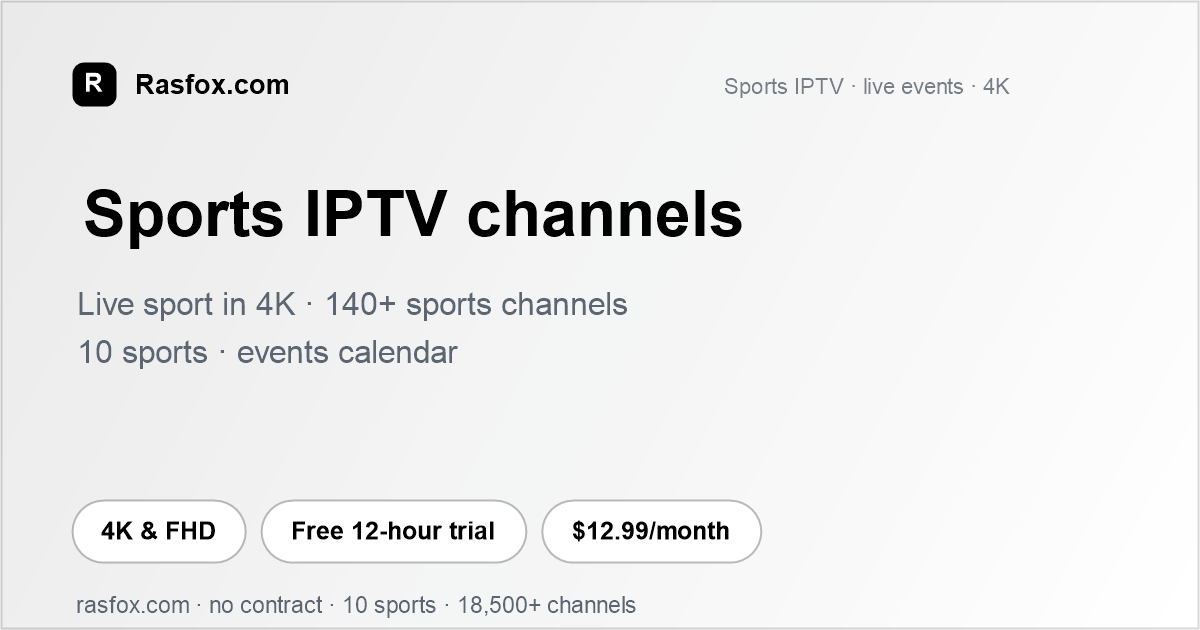
That is exactly where IPTV enters the conversation. Internet Protocol Television — IPTV for short — delivers live channels and on-demand content over your existing internet connection instead of a coaxial cable or satellite dish. Done right, it can replace a $120 cable package with a lean, sports-first setup that costs a fraction of the price and streams in crisp 4K. In this guide, we will look at IPTV through a personal-finance lens: what it is, how it fits into a smart household budget, what it costs, how to set it up, and how to choose a provider that will not put your money or your data at risk.
What Is IPTV — and Why Does It Matter for Sports Fans?
IPTV is not a gadget or a hack. It is a delivery method. Instead of tuning a cable box to a broadcast frequency, your TV, phone, tablet, or streaming stick requests a video stream from a server over the internet — the same way Netflix or YouTube works. The difference is that IPTV can carry live linear channels in real time: news, movies, kids' programming, and above all, live sports.
For a sports fan, that distinction is everything. On-demand platforms are built around box sets and films. They treat a live football match as an afterthought — and they charge premium prices for the privilege. IPTV, by contrast, was designed for linear, scheduled, real-time television. That makes it the natural home for:
- Live football and soccer — Premier League, La Liga, Serie A, Bundesliga, MLS, Liga MX, Brasileirão, Copa Libertadores.
- Combat sports — UFC pay-per-view cards, boxing main events, and weekly fight nights.
- Motorsport — every Formula 1 race weekend, practice sessions, and qualifying.
- US leagues — NFL, NBA, MLB, NHL, and college sports.
- International coverage — beIN Sports, Sky Sports, DAZN, Eurosport, and regional networks that US cable simply does not carry.
In short: IPTV gives you the breadth of a global satellite package at the price of a mid-tier streaming subscription. For a household already watching its bottom line, that gap is not a small detail — it is real money, every single month.
The Budget Case: How IPTV Fits Into a Household Financial Plan
Let's talk numbers, because that is what a credit union member actually cares about. The average US household spends somewhere between $100 and $200 per month on television: a base cable or satellite package, a sports tier, a DVR fee, equipment rental, and then two or three streaming subscriptions stacked on top.
Now compare that to a modern IPTV subscription, which typically runs a fraction of that cost and bundles everything into a single line item. For anyone working toward an emergency fund, a down payment, or simply a healthier savings rate, that is a painless way to free up $80 to $150 every month — without giving up the games.
A simple three-step subscription audit
Before you switch anything, do this exercise. It takes ten minutes and it will change how you think about your entertainment spending.
- List every recurring media charge on your last two bank statements. Cable, satellite, sports tiers, streaming apps, rental fees. Add them up, then multiply by twelve. Most people are shocked by the annual figure.
- Mark what you actually watch. If 70% of your viewing is live sports, you are paying a premium for hundreds of channels you never open.
- Replace, don't stack. The biggest budgeting mistake is adding IPTV on top of cable "just to try it." Cancel the legacy package and let the savings land in your account.
If you want a low-risk way to test the third step, a provider offering a 24-hour free IPTV trial lets you verify picture quality, channel lineup, and reliability before a single dollar leaves your account. That is the same principle you would apply to any major purchase: never pay for a service you have not tested.
Where IPTV sits next to your other fixed costs
Financial planners often group expenses into "fixed," "flexible," and "discretionary." Television sits awkwardly between all three — it feels non-negotiable, but it is one of the easiest categories to optimize. Moving from a bundled cable contract to a no-contract IPTV service converts a locked-in, rising fixed cost into a flexible one you control. No early-termination fees, no annual price hikes you did not agree to, no equipment rental that outlives its usefulness.
For families living paycheck to paycheck, the psychological benefit matters as much as the money. Cutting a bill you resent and keeping the thing you actually love — Saturday football with friends, a UFC card with your brother, Sunday races with your dad — is a rare "win-win" in personal finance.
Built for Sports: Inside RasFox.com and the Radio Malena Legacy
Most IPTV providers are generalists. They buy a bulk channel list, wrap it in a generic app, and hope nobody asks too many questions. RasFox.com took a different path: it was built with a total focus on sports channels and live sports events.
The story behind it is unusual. The team comes out of Radio Malena 89.1 FM in Buenos Aires — Venezuela 370 — a station steeped in tango, Argentine culture, and the tradition of broadcasters who talk about football the way other people talk about religion. That background shaped everything: a service designed by people who actually watch matches, understand kick-off schedules across time zones, and know that a stream freezing in the 89th minute is not a minor inconvenience — it is a disaster.
From that Argentine broadcasting heritage, the platform expanded to serve lusophone and Latino communities worldwide — Brazilian families in Florida, Portuguese expats in New Jersey, Argentine and Colombian households in Texas and California, and English-speaking sports fans who simply want more football for less money.
What the sports-first lineup actually includes
RasFox delivers roughly 12,000 live channels and 40,000 on-demand titles, with sports at the center of the offering. Streams run up to 4K at 50FPS — the frame rate that makes fast-moving sport look genuinely smooth rather than smeared. Highlights of the sports catalog include:
- Worldwide networks: ESPN, DAZN, Fox Sports, beIN Sports, Sky Sports, Eurosport.
- Latin American coverage: TyC Sports, ESPN Premium, TNT Sports Argentina, Fox Sports, DirecTV Sports.
- Brazilian coverage: Globo, SporTV, Premiere, ESPN Brasil, BandSports, Combate, TNT Sports BR.
- Portuguese coverage: Sport TV 1–6, Eleven Sports, Benfica TV, Porto Canal, DAZN Portugal.
- Competitions: Champions League, Premier League, La Liga, Brasileirão, Copa Libertadores, Liga Portugal, Liga Argentina, plus F1, UFC, boxing, NFL, NBA and MLB.
Two things stand out for budgeting households. First, the subscription covers two simultaneous screens, so one account can serve the living room and a bedroom or tablet at the same time — no duplicate subscription needed. Second, the service is explicitly marketed as IPTV that doesn't buffer, backed by infrastructure sized for peak-time traffic when every fan in the country is watching the same match.
Support is available in Portuguese and Spanish as well as English, which matters enormously for immigrant families and bilingual households who have been burned before by providers that vanish the moment something breaks.
IPTV in the United States: Channels, Internet, and Legal Reality
The US is arguably the best market in the world for IPTV, and it has nothing to do with the content. It is the infrastructure. Broadband penetration is high, average fixed-line speeds comfortably exceed what 4K streaming requires, and most households already own a streaming device. If you can watch Netflix in HD without stuttering, you can run IPTV.
What drives Americans to IPTV is the gap between what cable sells and what fans want. A US cable package gives you domestic leagues, a handful of international channels, and a pile of home-shopping networks. It does not give you full Champions League coverage, Brazilian league football, Argentine Primera División, or the Portuguese Primeira Liga — unless you buy specialized add-ons that cost more than the base package itself.
IPTV solves that by aggregating global feeds into a single interface. For a household with roots in Latin America or Brazil, this is transformative: parents who grew up with Globo or TyC Sports can watch in the original language, in real time, without hunting for a bootleg stream on a laptop.
Legal vs. unlicensed: the distinction that matters
Here is the honest version, because financial literacy and legal literacy go together. The technology is legal. IPTV as a delivery method is used by major telecoms, broadcasters, and streaming platforms everywhere, including in the United States. What determines legality is licensing — whether the operator has the rights to redistribute the channels it carries.
That is precisely why due diligence matters. An unlicensed service can disappear overnight, taking your prepaid subscription with it. It may also expose your devices and network to malware, intrusive ads, or data harvesting. For a household managing a budget carefully, an unreliable grey-market provider is the worst of both worlds: you save money on paper and lose it in practice.
The safe approach is to choose a provider with transparent terms, public contact channels, responsive customer support, a trial period, and a clear refund or cancellation policy. Being able to test the service for free before you subscribe is a strong signal that the operator is confident in what it delivers — and it protects you from paying in advance for something you have never seen work.
Hardware and Setup: What You Actually Need
One of the most underrated financial advantages of IPTV is the equipment. Traditional cable requires a rented box per television, often at $10 to $15 per month, per device — a cost that compounds silently for years. IPTV needs no proprietary hardware at all.
Here is a practical starter kit for a typical US household:
- A stable internet connection. 15–25 Mbps is comfortable for Full HD; 40 Mbps or more is ideal for 4K streams, especially if several people are online at once.
- A streaming device. Amazon Fire TV Stick, Android TV box, Apple TV, Chromecast, Roku, or a smart TV with an app store. Many households already own one.
- Optional: an Ethernet cable. Wi-Fi works well, but a wired connection to your main TV eliminates the most common cause of buffering during big matches.
- A router that can handle simultaneous streams. If the service supports two screens, make sure your home network does too.
Setup in five minutes
- Install the recommended IPTV player app on your device.
- Enter the credentials or playlist link you receive after signing up.
- Wait for the channel list to load — the first sync can take a few moments with a 12,000-channel library.
- Use the built-in category filters to jump straight to Sports, Football, or Live Events.
- Save your favorite channels so match day is a two-click process.
That is genuinely the whole process. For households where one person manages the technology, a single afternoon is enough to cut the cord, order a sports-focused IPTV package, and cancel the cable contract — ideally before the next billing cycle begins.
Is IPTV Cheaper Than Cable? The Long-Term View
Consider a household paying $140 per month for cable with a sports tier. Over three years, that is just over $5,000. The same household moving to a no-contract IPTV plan at a typical monthly rate would spend a small fraction of that — and could redirect the difference into a savings account, a retirement contribution, or a car loan payoff.
Compound that over a decade and the gap becomes genuinely life-changing. This is why credit union members, in particular, tend to appreciate IPTV once they understand it: it is not a luxury upgrade, it is a line-item optimization that improves cash flow without reducing quality of life. In fact, for a sports fan, quality of life usually goes up — more matches, more leagues, better picture, and no blackout frustration.
The catch, as always, is choosing the right provider. Prioritize reliability over the lowest possible price. A service that buffers during the Champions League final is not a bargain at any price. Look for 4K 50FPS streams, multi-screen support, no-contract billing, a free trial, and real human support in a language you speak.
Frequently Asked Questions About IPTV
Is IPTV legal in the United States?
IPTV technology is completely legal and widely used. What matters is whether the provider holds redistribution rights for the channels it offers. Choosing a transparent, well-established service with clear terms and customer support is the safest route — and testing it with a trial before paying is always wise.
How much internet speed do I need for IPTV in 4K?
Around 15–25 Mbps is enough for Full HD, while 4K streams generally need 40 Mbps or more per screen. If multiple people stream simultaneously, add roughly 15–20 Mbps per additional device.
Can I watch live football, UFC, and Formula 1 with IPTV?
Yes — live sport is the core strength of sports-focused IPTV services. RasFox.com, for example, carries ESPN, DAZN, Fox Sports, beIN Sports, Sky Sports, TyC Sports, SporTV, and Sport TV, covering the Champions League, Premier League, La Liga, Brasileirão, Copa Libertadores, F1, UFC, and much more.
Do I need a contract or special equipment?
No. Modern IPTV services are contract-free, require no proprietary box, and work on devices you already own — Fire TV Stick, Android TV, Apple TV, smartphone, tablet, or smart TV. Most subscriptions also include a 24-hour free trial so you can confirm quality first.
How many screens can I use at once?
Good providers typically support two simultaneous screens per subscription, which covers most households without forcing a second plan. If you have a larger family, check the provider's multi-screen options before subscribing.
The Bottom Line: Keep the Games, Cut the Waste
Streaming has changed television the same way online banking changed personal finance: it removed the middleman, cut the overhead, and put control back in the customer's hands. IPTV is that shift applied to live TV and live sport — a way to get more football, more UFC, more Formula 1, and more international coverage for a fraction of what a cable contract demands.
For credit union members and budget-conscious households, the logic is straightforward. Audit your subscriptions. Test a service before you commit. Cancel the package you resent. Then put the savings to work.
If you want to start with a platform that was designed around live sports from day one — 12,000 channels, 40,000 on-demand titles, 4K 50FPS streams, two screens, no contract, and support in Portuguese, Spanish, and English — take a look at RasFox.com and run the free 24-hour trial. Watch a full match. Judge the picture. Then decide. That is how smart households make every other financial decision, and it works just as well for your television.